Introduction to Scuba Diving
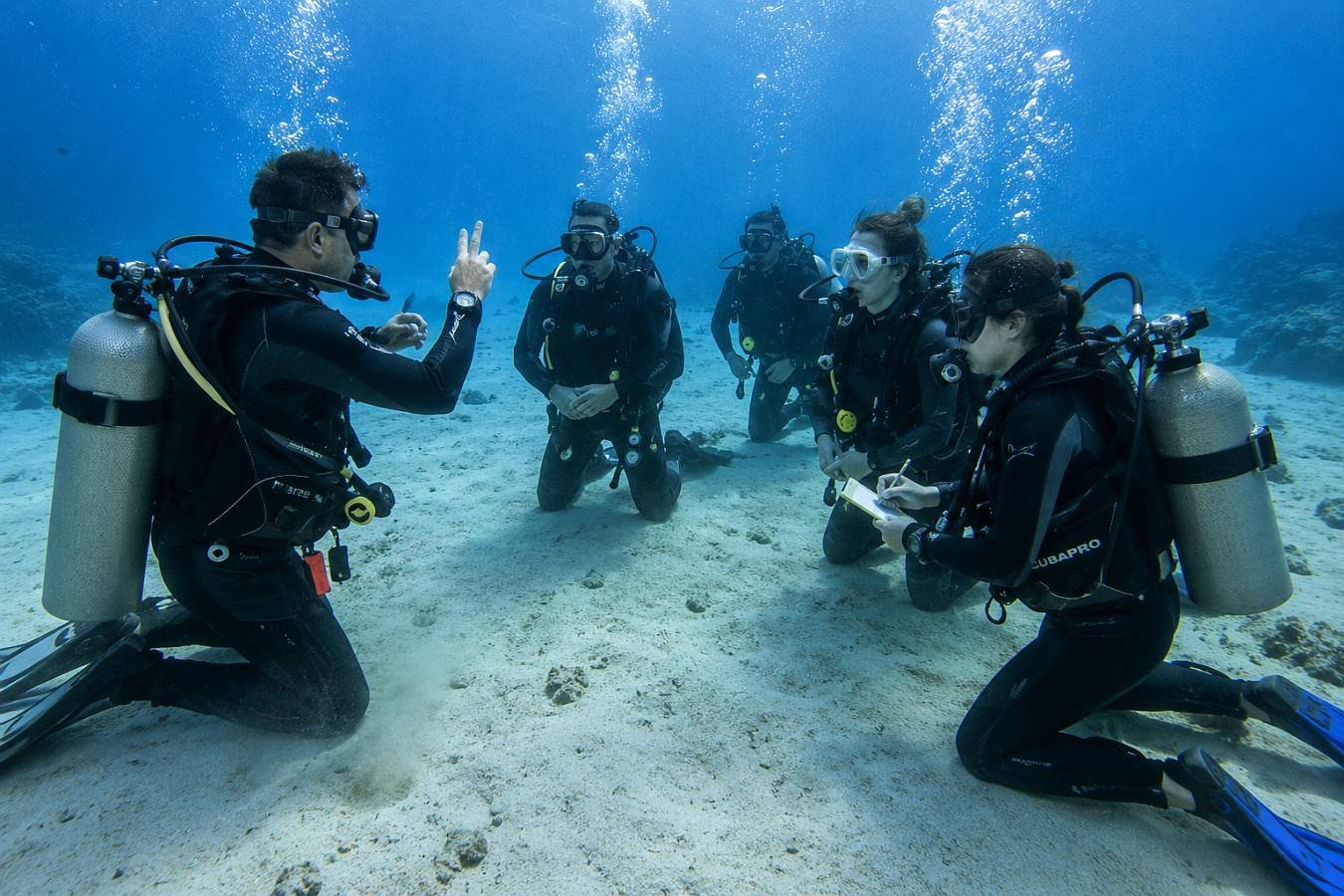
Scuba diving looks simple from the outside, but underwater, you quickly realise that there is much more to it than putting on a mask and breathing from a tank. Before your first dive, you need to understand a few basic scientific principles, such as how pressure affects your body, how gases behave underwater and how buoyancy allows you to control your position in the water. You also need to learn the practical skills that keep you safe and comfortable. This is why scuba diving requires proper training and certification before you can dive. I found that learning the theory alongside the practical skills made the whole experience much more enjoyable. Understanding how things work at depth gave me much greater confidence in the water.
Breathing Compressed Air
When we scuba dive, we are not breathing the air around us at the same pressure as we do on the surface. The air in a scuba cylinder has been compressed to a high pressure, usually 210 bar (3000 psi), and is delivered to the diver through a regulator. The regulator reduces the pressure of the gas so that it can be breathed comfortably at the surrounding water pressure. As we descend, the pressure around us increases, and the gas we breathe is delivered at that higher pressure as well. The regulator is the central piece of scuba equipment, not simply because it supplies air, but because it delivers that air at the surrounding ambient pressure, keeping the volume in our lungs constant as the pressure around us changes.
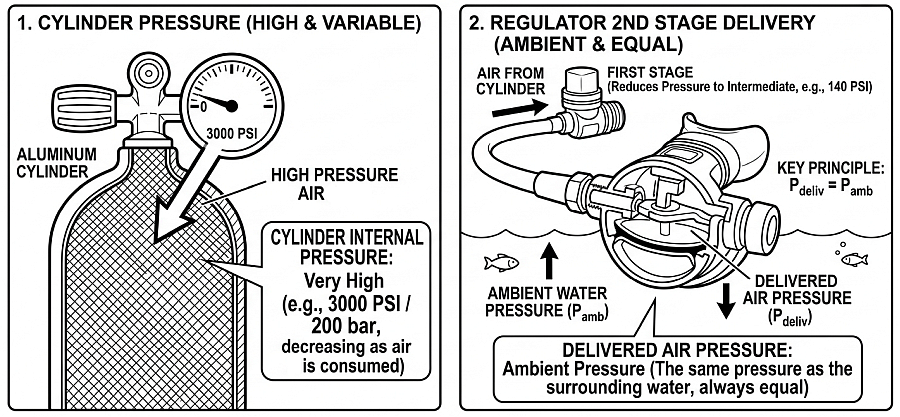
This change in pressure is one of the first things that makes scuba diving different from breathing on land. At greater depth, each breath contains more gas molecules than the same breath at the surface. The air therefore becomes denser, and breathing can require more effort. I noticed that this is one of those things that is easy to overlook when you are learning to dive. The regulator makes breathing feel quite natural, so it is easy to forget that the air reaching your lungs is being supplied at a much higher pressure.
There is another important consequence of breathing compressed air. The nitrogen and oxygen in the air are also being breathed at higher pressures. Your body absorbs more nitrogen as you spend time underwater, particularly during deeper or longer dives. This is why divers need to understand depth, time, ascent rates and decompression procedures. The nitrogen itself is not harmful simply because you are breathing it, but the way it enters and leaves your body becomes an important part of safe diving.
Depth also changes the way the gas behaves in your body. Air spaces such as your lungs, ears and sinuses are affected by changes in pressure. Divers need to equalise and control their descent and ascent carefully. Understanding these basic effects does not require an advanced scientific background. Once you understand what pressure is doing to the gas you breathe and to the spaces inside your body, many of the rules taught during diver training make much more sense.
Buoyancy
Buoyancy is one of the things that makes scuba diving feel different from swimming or snorkelling. On the surface, we are used to float or sink depending on how we position our body. Underwater, we can control our buoyancy much more precisely and learn to stay at a particular depth without constantly swimming up or down. When I first started diving, becoming comfortable with this was one of the skills that required some training.
The amount of buoyancy we have depends on several things, including our body, our exposure protection, the equipment we carry and the amount of air in our lungs. Our wetsuit also plays an important role because the material contains tiny gas filled cells that provide buoyancy. As we descend, the increasing pressure compresses these cells, reducing their volume and therefore reducing their buoyancy. A diver becomes less buoyant as they go deeper.
The Buoyancy Compensator, or BC, gives us a practical way to manage these changes. By adding air to the BC, we increase its volume and make ourselves more buoyant. Releasing air has the opposite effect. With practice, small adjustments become enough to maintain a comfortable position in the water without having to rely constantly on our fins.
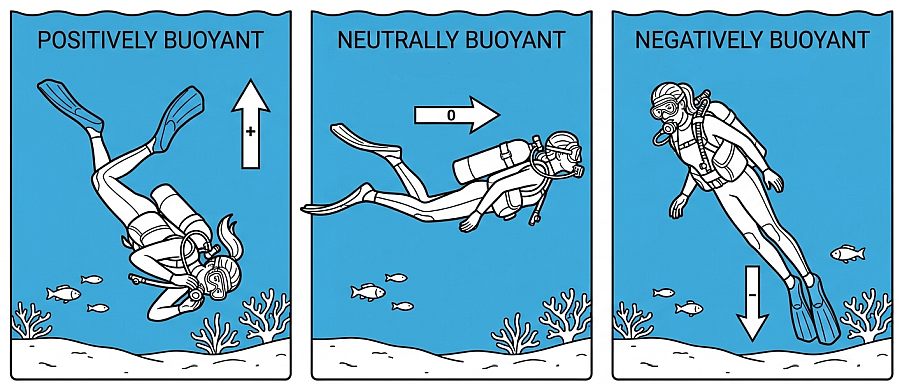
Good buoyancy is about much more than simply staying at the right depth. It helps conserve air, reduces unnecessary effort and makes the dive more enjoyable. It also allows us to move close to the seabed without touching it, which is particularly important when diving around coral, plants and other fragile marine life. Once buoyancy starts to become instinctive, diving feels less like swimming underwater and more like simply being there, like a fish.
Pressure Underwater
Pressure is one of the things that impressed me when I started diving. On the surface, we are surrounded by air pressing against us, but we rarely notice it because we live with it every day. Once we enter the water, things change quickly. The deeper I go, the more water there is above me, and the greater the pressure becomes.
The change is surprisingly noticeable during the first few metres of a descent. I can feel it in my ears as the increasing pressure pushes against the air spaces in my body. This is why equalising is such an important part of diving. By gently adding air to the middle ear, I can balance the pressure on both sides of the eardrum and continue my descent comfortably. If I ignore the discomfort and keep going down, the pressure can cause pain and potentially injure the ear.
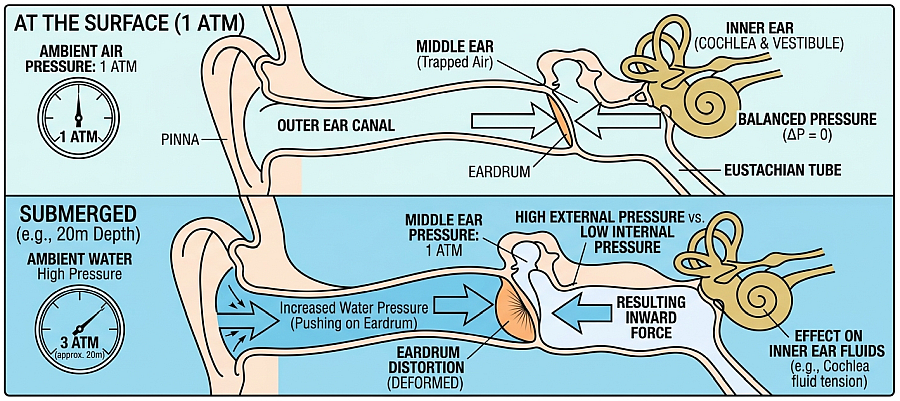
Pressure also affects the air in my equipment and in my lungs. As I descend, the gas I breathe is delivered at the surrounding pressure, so the same volume of air contains more gas molecules. As I ascend, the pressure decreases and the gas expands again. This simple relationship between pressure and volume is behind many of the things we learn during diver training, including why we must never hold our breath while ascending.
One of the easiest ways to appreciate pressure is simply to observe what happens to a baloon during a dive. The air in a baloon becomes compressed as it descends, reducing its volume. The air space in my mask also becomes smaller unless I add a little air through my nose. Even the air inside my BC changes in volume as I move between different depths.
Understanding pressure has made diving much more intuitive. Rather than thinking of the rules I have to remember, I can see how they follow from what is happening around me. The deeper I go, the more pressure I experience, and every change in depth brings a corresponding change in the gases around and inside me. And I need to compensate it to keep my buoyancy.
Ear compensation is one of the major concerns of every diver. Not compensating properly can lead to barotrauma, causing pain, infection and potentially damaging the ears. As I descend, I start compensating early and often rather than waiting until I feel pressure or discomfort. I gently pinch my nose and blow very lightly, swallow, yawn, or move my jaw from side to side to help open the passages between my ears and throat. I find that different techniques work at different times, so I use whichever feels most natural and effective for me. The important thing is to stay relaxed and never force the compensation. If my ears do not clear easily, I stop descending, rise slightly and try again before continuing. A slow, controlled descent gives me plenty of time to compensate comfortably and helps me avoid unnecessary pressure on my ears.
Another important procedure is to equalise the air inside the mask as we descend, by gently breathing out through the nose. The increasing pressure can pull the mask tightly against the face and cause a mask squeeze, leaving red marks, broken blood vessels around the eyes or even some bruising. This can be more noticeable for divers suffering from sinusitis, as congestion can make it harder for the air to move freely through the nose and sinuses. It is not dangerous, but it can certainly be ugly and uncomfortable, with some bleeding inside the mask.
Why Divers Ascend Slowly?
The effects of breathing compressed gases are commonly referred to in the diving community as decompression. When divers descend underwater, the pressure increases and the body absorbs more of the gases being breathed. These gases dissolve in the body. When returning towards the surface, the pressure starts to decrease and the dissolved gases expand. This change is something we need to manage carefully because the gases that have dissolved in the tissues need time to leave the body safely. This is where decompression comes into the picture.
One of the most important habits in diving is making a slow and controlled ascent. We do not simply swim towards the surface quickly once the dive is finished. We must give our bodies time to adjust as the surrounding pressure decreases. Ascending slowly also gives us the opportunity to deal with any problems, check our instruments and maintain good control of our buoyancy.
Decompression is not only something that happens during a formal decompression stop. Every ascent involves some degree of decompression because the pressure is continuously changing. Even on a straightforward recreational dive, we need to respect the ascent rate and complete any required safety stop. These simple habits become second nature with experience, but they are an important part of keeping a dive safe.
If decompression is not managed properly, the dissolved gases in the body may not have enough time to leave safely. As the pressure decreases, these gases can form bubbles in the tissues and bloodstream, potentially causing decompression sickness. The effects can range from pain, tiredness and dizziness to more serious problems affecting the nervous system, lungs or other organs. In severe cases, decompression sickness can be life threatening. This is why a controlled ascent should always be treated as an important part of every dive. Divers should respect the dive plan, perform the required decompression stops and, when appropriate, add a short safety stop at the end of the dive, usually for three minutes at a depth of five metres.
The science behind decompression can seem complicated at first, but the basic idea is quite simple. The deeper we go and the longer we stay there, the more gas our bodies can absorb. When we ascend, that gas needs to be released gradually.
A commonly recommended ascent rate for recreational diving is around 10 metres per minute, or 30 feet per minute. DAN notes that current recommendations commonly favour this limit, although recommendations from training agencies have historically ranged higher. PADI, for example, recommends no faster than 18 metres per minute, while BSAC tables allow a maximum of 15 metres per minute before 6 metres and require the final 6 metres to the surface to take at least one minute. In practice, the safest approach is to follow the ascent rate shown by the dive computer and keep the ascent slow and well controlled, particularly as the diver approaches the surface where changes in pressure become proportionally greater.
Underwater Communication
Underwater communication is something we quickly learn to appreciate because talking normally is not possible while using a standard regulator. Most of the time, we rely on hand signals to communicate with our buddy. These signals are simple and easy to understand once we have practised them. We use them to say that everything is OK, ask whether our buddy is OK, indicate that we need to ascend or descend, or draw attention to something around us. Good communication gives us confidence and helps us stay aware of what our buddy is doing throughout the dive.
Recreational diving generally relies on a small set of commonly recognised hand signals. We may use the OK signal to show that everything is fine, point towards something interesting, or use signals to indicate low air, a problem or the need to return. Some signals can vary slightly between training organisations or groups, so it is important that we agree on the signals we will use before entering the water. This becomes particularly important when diving with someone we have not dived with before.
Technical diving often requires a much wider range of signals because the dives can involve more equipment, task loading and complex procedures. Technical divers may use specific hand signals for gas changes, decompression, stage cylinders, line work and other procedures. We also need to be clear about how we communicate when wearing thick gloves or when visibility is poor. Before a technical dive, our team normally reviews the signals we expect to use so that there is no confusion when something needs to be communicated underwater.
Hand signals are not always enough, particularly when we need to exchange more detailed information. An underwater writing slate or wetnotes can be very useful for this. We can write down a depth, time, gas pressure, plan or other information that would be difficult to communicate with our hands. Wetnotes are especially useful in technical diving because they allow us to record information and communicate more precisely when several details need to be shared.
Another option is a full face mask equipped with an underwater communication system. These systems can allow divers to speak to each other through a microphone and speakers, making communication much more natural. They can be particularly useful for professional diving, training, public safety work and some technical diving situations. Even when we have voice communication available, we should still know and understand basic hand signals because electronic equipment can fail or may not be available during every dive.
Whatever method we use, good underwater communication starts before we enter the water. We should agree on the important signals, make sure everyone understands them and clarify anything that is unfamiliar. Once we are underwater, clear and deliberate communication helps our team work together and makes it much easier to respond calmly when something unexpected happens.
Are We Ready to Dive?
Scuba diving is a sport that can be enjoyed at different ages. What matters most is being medically fit to dive and having the appropriate training for the type of diving we want to do. We do not need to be exceptionally fit or athletic to enjoy recreational diving. Good general fitness certainly makes diving easier and can help us cope better with the physical demands of the water, but diving is not a competition. For many of us, it is a calm and relaxed way to explore a completely different environment.
Being comfortable in the water is just as important as physical fitness. We need to be able to swim and manage ourselves confidently in the water, but most of the work during a dive should be slow and controlled. There is no need to rush. Good buoyancy, relaxed breathing and sensible finning techniques allow us to move around efficiently without unnecessary effort. As our experience grows, we usually find that diving becomes less physically demanding because we learn to use our equipment and our body more efficiently.
Rest is an important part of preparing for a dive. We should arrive at the dive site feeling rested rather than tired or exhausted. Diving requires concentration and good judgement, and fatigue can affect both. A good night's sleep and enough time to recover between dives can make a noticeable difference to how we feel underwater.
We should also avoid alcohol before diving. Even when we do not feel particularly affected, alcohol can impair judgement, coordination and reaction times. Instead, we should drink plenty of water and make sure we are properly hydrated. Spending time in the sun, travelling to a dive site and breathing dry compressed gas can all contribute to dehydration, so keeping a bottle of water nearby is a simple habit worth developing.
Perhaps most importantly, we should stay calm. Diving is rarely improved by rushing or reacting emotionally to a problem. If something does not feel right, we can stop, breathe, think and communicate with our buddy before deciding what to do. Never be afraid of saying "no" or cancelling a dive if it's not your day. We, divers, have all been there. With the right preparation and attitude, diving can be an enjoyable and remarkably peaceful activity at almost any stage of life.