The Physics Behind Diving - The Hidden Effects of Nitrogen
When we breathe compressed air underwater, we take in nitrogen at a higher pressure than we would at the surface. Our lungs transfer the nitrogen from the breathing gas into the bloodstream, and the blood then carries it around the body. From there, nitrogen moves into our tissues. The deeper we go, the greater the surrounding pressure becomes and the greater the pressure of the nitrogen we breathe. This creates a stronger driving force for nitrogen to enter our tissues.
Nitrogen does not simply collect in one place. Different tissues absorb and release it at different rates. Tissues with a good blood supply, such as muscles and other soft tissues, can absorb nitrogen relatively quickly. Other tissues have a poorer blood supply and absorb nitrogen more slowly. The amount of nitrogen that a tissue can hold depends on the pressure around us and on the characteristics of that particular tissue.
While we remain at depth, nitrogen continues to move between the blood and our tissues until they approach a state of equilibrium with the surrounding pressure. If we stay at a particular depth long enough, the tissues gradually become loaded with nitrogen. This is why both depth and time matter when we plan a dive. Going deeper increases the pressure difference, while staying deeper for longer gives our tissues more time to absorb nitrogen.
As we ascend, the pressure of nitrogen in the surrounding breathing gas falls. Nitrogen dissolved in our tissues can then move back into the blood and eventually reach the lungs, where we breathe it out.
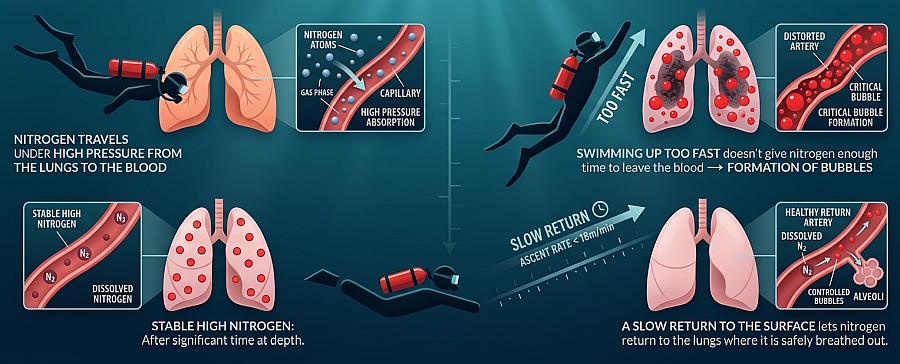
If the pressure around us decreases too quickly, nitrogen can come out of solution faster than our body can transport and eliminate it through the lungs. Small bubbles may then form in tissues or the bloodstream. These bubbles can interfere with normal circulation and tissue function and are associated with decompression sickness. This is why we control our ascent and follow appropriate decompression procedures rather than treating the ascent as simply the final part of the dive.
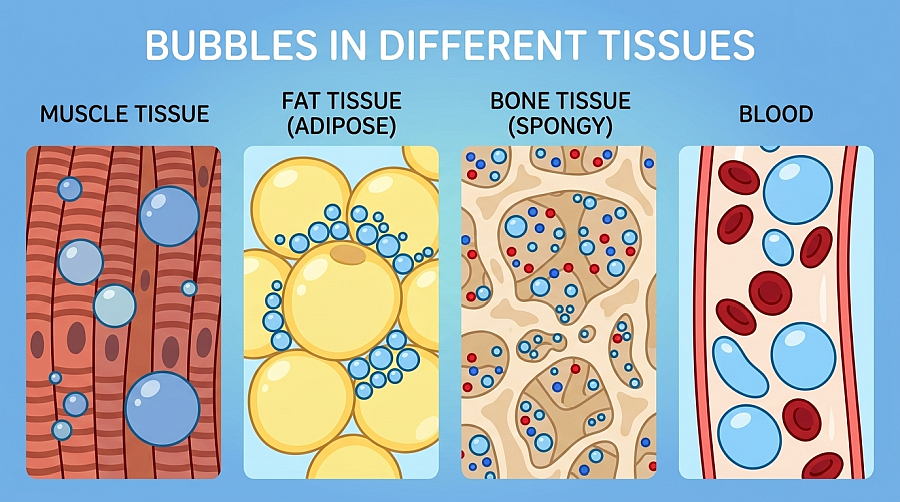
We can think of our tissues as a collection of compartments that fill and empty at different speeds. Some become loaded with nitrogen quickly and also release it quickly, while others take much longer to reach equilibrium and need more time to release the nitrogen. This is one of the reasons why dive tables and dive computers are useful. They use mathematical models to estimate how much nitrogen our different tissues may have absorbed and how much time we need to allow for its safe release during and after the dive.
The effects of bubbles forming in our tissues will be explained in more detail in the article on decompression illness