The Physics Behind Diving - Water Pressure and Gas laws
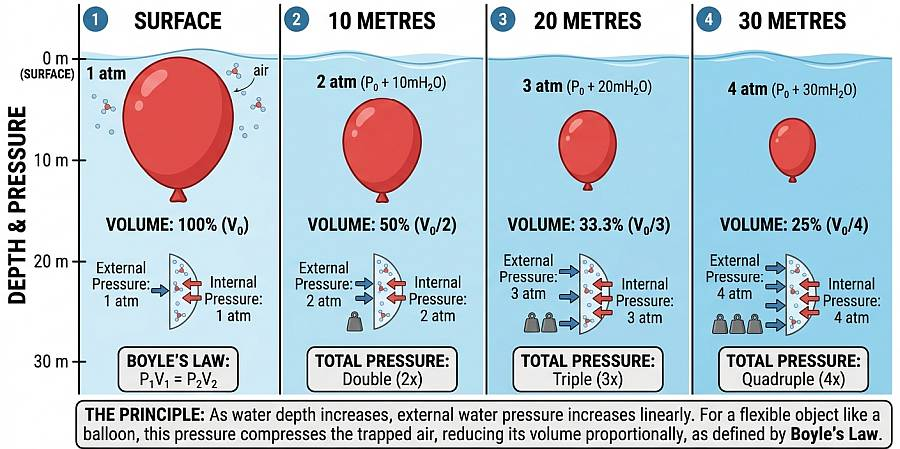
As we descend, the pressure around us increases. At sea level, atmospheric pressure is about 1 bar. As we go deeper, the water above us adds more pressure. In seawater, we gain roughly 1 bar for every 10 metres (33 feet) of depth. This means that at 10 metres we are exposed to about 2 bar of absolute pressure, at 20 metres (66 feet) about 3 bar, and at 30 metres (98 feet) about 4 bar.
This change in pressure becomes especially important when we dive. When pressure increases, the volume of a gas decreases. When pressure decreases, the gas expands. We can experience this quite clearly during a dive. As we descend, the air spaces in our mask, ears and lungs are compressed. As we ascend, the same air expands again. This is why we need to equalise the air spaces in our ears and mask while descending. We also need to control our ascent because the air in our lungs expands as the surrounding pressure falls. Holding our breath during an ascent can therefore be extremely dangerous.
The relationship between pressure and volume is described by Boyle's law. It applies when the amount of gas and its temperature remain constant.
P₁V₁ = P₂V₂
If the pressure doubles, the volume is reduced by half.
Our scuba equipment allows us to breathe normally underwater by delivering breathing gas at the same pressure as the water around us. This is known as ambient pressure. As we descend, the surrounding pressure increases, so the regulator increases the pressure of the gas it delivers to match it. This means that the breathing gas reaching our lungs is at approximately the same pressure as the surrounding water. Our lungs can therefore function normally while we breathe underwater. Without this pressure matching, breathing from a cylinder would become increasingly difficult as we descended.
Dalton's law helps us understand what happens when we breathe a mixture of different gases. It tells us that the total pressure of a gas mixture is the sum of the partial pressures of its individual gases. These individual pressures are called partial pressures. Air contains mainly nitrogen and oxygen, so when we breathe air underwater, both gases contribute to the total pressure of the breathing gas.
As we descend, the total pressure increases. The proportion of oxygen and nitrogen in the air does not change, but their partial pressures increase because the surrounding pressure is higher. For example, at the surface, where the pressure is about 1 bar, oxygen makes up roughly 21 percent of the air, giving us an oxygen partial pressure of about 0.21 bar. At 30 metres (98 feet), the ambient pressure is about 4 bar, so the oxygen partial pressure in air is about 0.84 bar.
Pₜ = Pₙ + Pₒ + ...
Total Pressure = Partial Pressure of Nitrogen + Partial Pressure of Oxygen + Partial Pressure of other gases
This becomes particularly important when we consider oxygen toxicity. Oxygen is essential for us, but breathing a high partial pressure of oxygen can become harmful. The risk depends not only on the percentage of oxygen in the breathing gas, but also on the pressure at which we breathe it. As we go deeper, the partial pressure of oxygen increases even though we are still breathing ordinary air.
A commonly used planning limit for the partial pressure of oxygen during the working part of a dive is 1.4 bar. The depth at which we reach this partial pressure depends on the oxygen content of our breathing gas. With normal air, which contains about 21 percent oxygen, this occurs at approximately 57 metres (187 feet). This does not mean that 57 metres is a suitable depth for recreational air diving. Other factors, including nitrogen narcosis, gas density and decompression requirements, become increasingly important as we go deeper. Many recreational diving agencies use 40 metres (131 feet) as the maximum depth for appropriately trained recreational divers.
Many entry level recreational certifications limit newly qualified divers to around 18 metres (60 feet). This gives new divers enough depth to experience a wide variety of underwater environments while keeping the effects of increased pressure and breathing gas consumption relatively manageable. As we gain experience and complete further training, we can progressively explore greater depths and learn how to manage the additional risks that come with them.